 quoture

Stoic quotes are often shared as instructions to become tougher. The original texts ask more demanding questions: What is my judgment adding to this situation? What can I choose? What do I owe other people? Reading with those questions gives a short line more depth than treating it as a command to stop feeling.
There is no single setting behind every Stoic quotation. Marcus Aurelius writes personal reminders in Meditations. The Enchiridion presents a compact account of Epictetus’s teaching, compiled by Arrian. Neither book is a collection of modern productivity slogans.
Start with the kind of claim
A quotation can describe the world, give advice, or challenge a habit of thinking. Those are different jobs. A sentence about judging an event is not necessarily a promise that the event is harmless. Advice about accepting an outcome does not mean approving the person who caused it.
Before applying a line, finish this sentence in your own words: “The author is asking me to reconsider…” If you can only repeat the quotation, you may not yet have understood its argument. Read the surrounding paragraph and try again.
Control means choosing your part
There are things which are within our power, and there are things which are beyond our power.
— Epictetus, Enchiridion, section 1, Thomas Wentworth Higginson translation.
The opening of Epictetus’s Enchiridion separates things that depend on us from things that do not. His examples include our judgments and choices on one side, and reputation or external possessions on the other. English translations render the distinction differently, so a familiar online wording may not match your edition.
A useful everyday application is preparing for a difficult conversation. You can decide what to say, check your facts, and listen. You cannot guarantee agreement. That distinction directs your effort; it does not make the conversation unimportant. See our note on Epictetus and control for the limits of this reading.
Marcus Aurelius includes other people
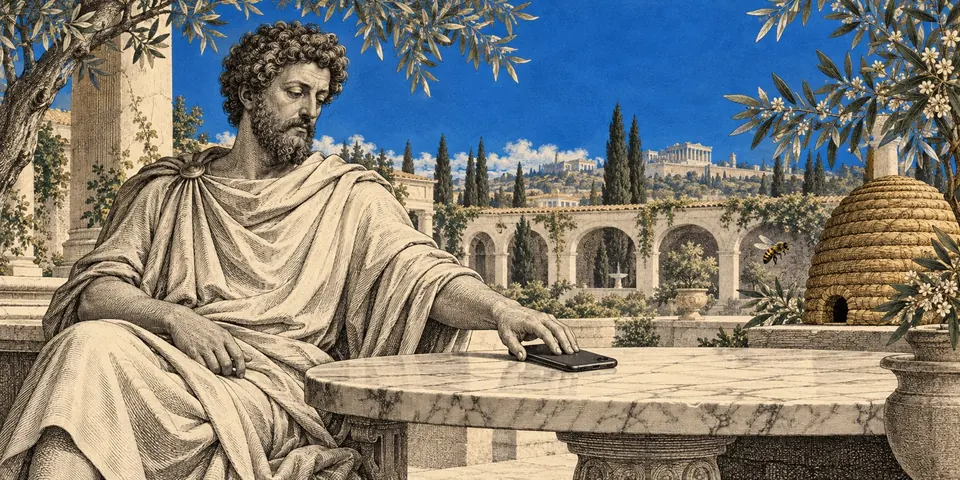
That which is not good for the bee-hive, cannot be good for the bee.
— Marcus Aurelius, Meditations, Book VI, section XLIX in Meric Casaubon’s translation.
In Book VI of Meditations, Marcus connects the welfare of a bee to that of its hive. The image matters because it interrupts an entirely private reading of Stoicism. Personal steadiness and shared life belong in the same picture.
If a supposed Stoic lesson makes every obligation to other people disappear, the bee and hive are a good test. Who else depends on the decision? What would happen if everyone acted on the same excuse? Our closer reading of the hive passage explores that social dimension.
Try an interpretation before repeating it
Take one short passage and write three things beneath it: what is happening, what the author argues, and where the claim might stop applying. For a sentence about fear, the limit might be that a danger is real and requires practical help. For a sentence about reputation, it might be that a false accusation still needs an answer.
This is slower than collecting twenty quotations. It also leaves you with an idea you can explain in a conversation without pretending an ancient writer has settled every modern problem.
Does being Stoic mean suppressing every emotion?
That is an unreliable shortcut. In these passages, the practical work concerns how we judge situations and choose to act. Treating sadness or fear as a personal failure can hide the very judgment that needs examination. A careful reader can acknowledge a feeling and still ask what response makes sense.
Start with a source you can locate, keep the wording attached to its edition, and read one paragraph beyond the line. The extra context is often where the useful part begins.