 quoture
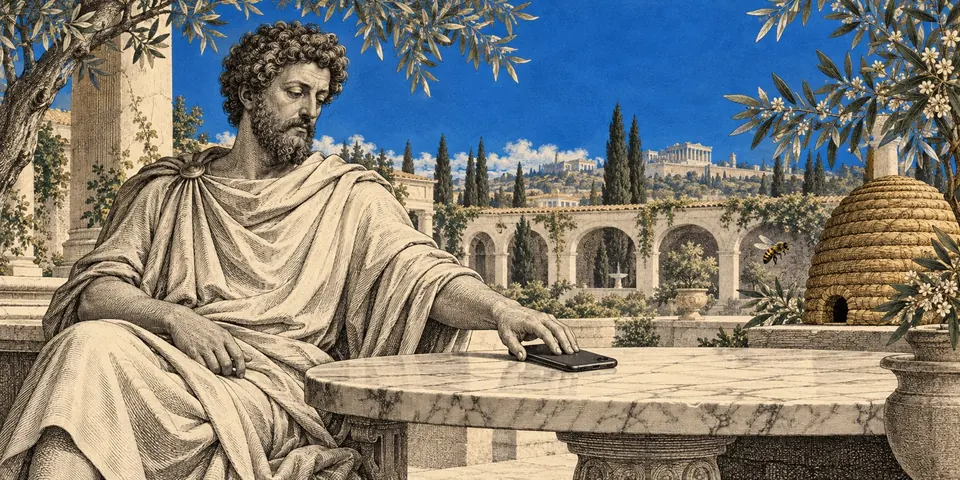
That which is not good for the bee-hive, cannot be good for the bee.
In Meric Casaubon’s translation of Meditations, this brief sentence appears in Book VI, section XLIX. Other editions divide and number the short passages differently. The wording and locator should travel together whenever you cite it.
The central idea is dependence. A bee belongs to a shared form of life. If the hive is damaged, the bee’s apparent private advantage may turn out to undermine the conditions it needs to survive. Marcus uses that image to question a sharp division between what benefits me and what benefits the people around me.
What is happening in Meditations?
Meditations is not a speech Marcus delivers to an audience about teamwork. It is a sequence of reflections and reminders. In the Casaubon text, the hive maxim follows advice about listening and sits near reflections on people relying on those who guide or care for them.
That setting supports a social reading, but the short line does not specify a complete political system. We should not make one sentence answer questions it never sets out to answer. Its force lies in changing where the reader looks when judging an advantage.
A social reading of Stoicism
Suppose a colleague takes all the credit for a shared project. For a moment, the colleague may benefit. Over time, trust and cooperation can weaken, making future work worse for everyone, including the person who took the credit. The hive image is a way to inspect that connection.
This example is an application, not a claim that Marcus was writing about an office. It makes the structure of the argument visible: an individual can depend on a common good even while feeling separate from it.
The same question can be asked of a household, a friendship, or a public space. What does this choice do to the shared conditions that make my own life possible? The answer might require a change in behavior rather than a change in attitude alone.
Does the quote justify conformity?
It should not be used as a shortcut to “the group is always right.” A group can harm its members. A leader can call a private interest the common good. The metaphor does not prove that every demand made in the name of a community is legitimate.
A careful application asks which good is genuinely shared, who bears the cost, and whether the proposed action actually protects that good. Those questions make the quote harder to use as an excuse for blind obedience.
How to bring it into a conversation
You could say: “Marcus Aurelius compares a person’s welfare with a bee’s dependence on its hive. I read it as a reminder that our private wins can depend on public trust.” That states both the image and your interpretation without pretending the sentence is a universal proof.
For the wider background, read Stoic quotes explained. If you are unsure how much context a short passage needs, our reading method offers a repeatable place to start.