 quoture
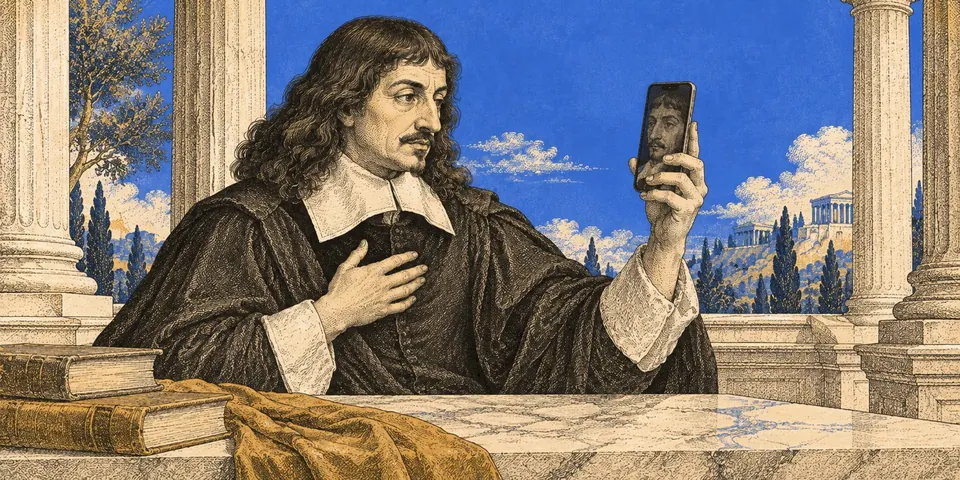
“I think, therefore I am” means that the act of thinking gives Descartes a point of certainty: while he is thinking, he cannot coherently deny that he exists. It is not a claim that optimistic thoughts create reality, or that a person must be clever to count as a person.
The familiar Latin name is the cogito. In Part IV of Discourse on the Method, Descartes reaches the thought after deliberately questioning beliefs he would ordinarily trust. The English wording varies by translation; the linked edition is John Veitch’s.
Why begin with doubt?
Descartes is looking for a secure starting point for philosophy. Instead of accepting everything that seems obvious, he considers how his senses can mislead him and how apparently sound reasoning can contain mistakes. He asks what could survive an unusually demanding attempt to doubt.
This is a method within an argument. It does not mean that he spends ordinary life refusing to recognize tables or talk to people. Treating the method as a permanent lifestyle makes the passage stranger than it needs to be.
The act survives the doubt
Try to doubt that you are thinking right now. The attempt is itself a thought. Even if what you think is false, the occurrence of that thinking is difficult to remove from the situation. Descartes takes this as a first secure point.
The argument does not depend on checking a photograph, touching a body, or receiving someone else’s agreement. It concerns what happens in the attempt to deny. That is why the surrounding doubt matters more than the phrase’s confident sound.
An everyday analogy is catching yourself making an error. Being wrong about the answer does not make the activity of answering disappear. The analogy is only a guide; Descartes’s claim is more fundamental than the ordinary fact that people sometimes make mistakes.
What does it prove?
In the passage, Descartes treats the connection between thinking and existence as a starting point. It does not by itself prove that every memory is accurate, that other minds exist, or that the external world is exactly as it appears. Those are further questions.
It also does not settle every dispute about what the thinking self is. A reader can understand the first step without accepting the whole philosophical system Descartes builds afterward. Distinguishing a step from a complete system is one of the most useful habits when reading short philosophical passages.
Why it is not a motivational quote
If someone uses the line to mean “believe in yourself and you can become anything,” the meaning has changed. That new thought may be encouraging, but it is not the argument in Part IV. Descartes is asking what he can know with certainty, not setting a goal for personal achievement.
A good conversational version is: “Descartes tries to doubt everything, but the doubting itself leaves him with a thinker who exists.” You have explained the mechanism rather than borrowed the prestige of a Latin phrase.
For another philosopher who uses questioning differently, read Socrates and the examined life. Their questions are not interchangeable, which is exactly what makes comparison worthwhile.